
Physical identity,
proven at the silicon.
A purpose-built secure element for physical products. Every GeBeCert identity is bound to a hardware tag that cannot be cloned, rewritten, or replayed.
Our ChipTech platform is built on NXP 13.56 MHz HF, ISO 14443-compliant secure elements. The chip is not a passive identifier — it is a stateful credential that participates in a challenge-response exchange with our verification infrastructure on every single scan.
Hardware specification
NXP · ISO 14443| Parameter | Specification |
|---|---|
| Manufacturer | NXP Semiconductors |
| Operating frequency | 13.56 MHz |
| Standard | ISO 14443 compliant secure element |
| Form factor | NTAG215 (504 bytes user memory) and NTAG216 (888 bytes user memory) |
| Access control | Password-locked user memory — 32-bit password, 32-bit pack, AUTH0 lock configuration |
| Payload | NDEF URL record for public routing, plus a rotating credential held in protected user memory |
| Credential lifetime | Single-use. Rotated on every successful verification, valid for 60 seconds |
| Reader compatibility | Native read on iOS and Android handsets — no proprietary reader or companion app required for the public layer |
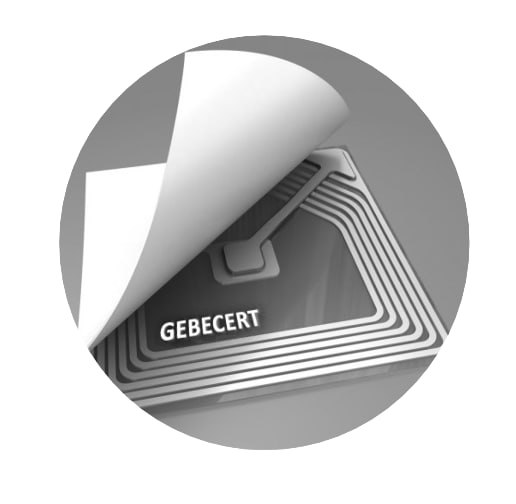
Embedded form factor
Physical layer
The rotating credential
Core mechanismA static identifier can be copied. A rotating credential cannot be copied, because the copy is wrong by the time it is presented. Our architecture replaces the stored secret on every successful verification, so a captured value has a sixty-second window and no reuse.
The NDEF record resolves a unique product route, for example https://brand.com/v/7f3a2b. This layer is public and intended to be read — it identifies the product, but it proves nothing on its own.
The application reads the current credential from password-locked user memory. Access requires the tag’s password, so the value cannot be harvested by a passive reader.
The credential is submitted to our verification endpoint together with the product identifier. The server compares it against the value currently held for that tag.
On a valid match the server issues a successor credential and the application writes it back to the tag. Tag and server are now synchronised, and the previous value is permanently dead.
The tag advances through manufactured → activated → verified → flagged. The final state is entered when scan velocity, geography, or count exceeds the configured threshold — a pattern consistent with a cloned tag being fielded in multiple markets.
Threat model
Attack → controlCopy the tag onto a counterfeit
The credential rotates on every verification, so the copy is stale within seconds. Cloning is not merely difficult — it is unprofitable, because the attacker must read the genuine tag to stay current.
Overwrite the payload on a new tag
User memory is password-locked and the lock byte is configured at manufacture. A new tag cannot be programmed to impersonate an issued identity.
Program a counterfeit UID
The UID is never treated as an authenticator. The NDEF route and the rotating credential are the authority, so a programmed UID confers no access.
Re-present a captured credential
Credentials are single-use and expire in sixty seconds. A recorded value cannot be replayed into a second acceptance.
Read the tag without the application
The credential lives in protected memory, so a passive reader sees only the public NDEF record. There is nothing valuable to harvest from the wire.
Field one tag in two markets
Scan counts and geography are tracked per tag. Divergent scans raise the tag into the flagged state, where the brand is notified before the counterfeit reaches consumers.
Integration surface
Developer interfaceBrands integrate the ChipTech stack without implementing radio handling or state management. The surface is deliberately small: read the tag, verify the credential, write the successor. Three calls, and the server owns the lifecycle.